Thermally Conductive Silicone: Types, Applications & Selection Guide
Thermal management is one of the most common failure points in modern electronics. As power densities rise and enclosures shrink, getting heat away from critical components decides whether a product runs at rated performance — or throttles, degrades, and fails early. Among thermal interface materials (TIMs), thermally conductive silicone is the most widely used family: it combines softness, temperature resistance and electrical insulation in one material. This guide covers the main forms, the applications where each wins, and how to select the right silicone thermal pad for your design.
1. What Makes Silicone a Good Thermal Interface Material
Silicone is a synthetic polymer built on a silicon-oxygen backbone, which gives it properties that organic rubbers cannot match:
- Thermal conductivity: filled with ceramic or metal-oxide particles, silicone pads and greases reach 1.0–8.0 W/m·K, with high-end pads above 10 W/m·K.
- Conformability: soft pads (Shore 00 20–70) compress under low pressure and fill microscopic air gaps between chip and heatsink. Air conducts only 0.026 W/m·K — eliminating trapped air is the real job of any thermal interface material.
- Temperature resistance: stable from −50 °C to 200 °C continuous, with special grades rated to 250 °C+.
- Electrical insulation: standard silicone TIMs offer >10 kV/mm dielectric strength, so pads can sit directly across live components.
- Compression set resistance: silicone recovers after repeated thermal cycling, maintaining contact pressure over years of service.
- Flame retardance: most grades meet UL 94 V-0.
2. Thermal Pad vs Thermal Gel vs Thermal Grease: Main Product Forms
Thermal pads are pre-cured sheets cut to shape. They offer easy handling, no mess, and consistent performance, making them the default choice for most designs — from standard silicone thermal pads to high thermal conductivity silicone pads above 8 W/m·K.
Liquid thermal gels are dispensed as a paste and cure in place. They absorb component height tolerance and fill complex cavities, and are increasingly used in automated assembly of power modules, EV battery electronics, and LED drivers. See our one-part liquid thermal gel for automated dispensing.
Thermal greases are pumpable pastes applied as an ultra-thin layer. They deliver the lowest thermal resistance of all silicone TIMs but require controlled dispensing and careful rework — our thermal grease is available in high-conductivity formulations.
Phase change materials are solid at room temperature and melt at operating temperature (45–60 °C), wetting both surfaces for maximum contact. Used in high-performance processors and rework-friendly assemblies, such as our phase change thermal material.
For structural or mechanical assemblies, a thermally conductive structural adhesive bonds and conducts heat in one step. Where silicone migration is a concern — sealed optics, vacuum or silicone-sensitive coatings — choose a non-silicone thermal pad instead.
Need a deeper side-by-side? Read our full comparison: Thermal Pad vs Thermal Gel vs Thermal Grease: How to Choose.
3. Thermal Pads for Consumer Electronics & LED Lighting
Smartphone SoCs, tablets, and laptops use thin pads and phase-change materials between processor and vapor chamber or heat pipe; low-outgassing grades protect camera modules and optics. In LED lighting, modules are bonded or padded to aluminum heatsinks with high-conductivity pads or dispensed gels. Keeping the junction temperature low directly extends lumen lifetime — every 10 °C reduction roughly doubles LED life.
4. Thermal Pads for Power Electronics, Inverters & IGBT Modules
IGBT modules and MOSFETs mount on pads that provide both heat transfer and electrical isolation, eliminating separate mica insulators. Liquid gels absorb the height tolerance of solder and component leads in automated lines. This is one of the fastest-growing categories — search demand for thermal pad for IGBT and thermal pad for inverter keeps rising as solar and EV power electronics scale up.
5. Thermal Pads for EV Batteries & Telecom Equipment
In EV battery systems, thermal pads and gels transfer heat from cells to liquid-cooled cold plates, managing temperature spread across the pack; flame-retardant, low-density grades reduce weight. In telecom, switches, routers, and optical modules run hot in compact racks — fiberglass reinforced thermal pads resist shear and puncture when compressed between PCBs and chassis. A low-density thermally conductive silicone gasket adds EMI or environmental sealing with minimal weight.
6. High Conductivity Silicone Pads for Military & Medical Equipment
Ruggedized pads with high reliability requirements are chosen where vibration, thermal cycling, and long service life matter. Military and medical assemblies often specify 5 W/m·K and above with full electrical isolation, and require documented material traceability — a standard offering from precision thermal pad manufacturers.
7. How to Choose the Right Silicone Thermal Pad
- Thermal requirement: estimate required conductivity from power loss, contact area and bond-line thickness. Pads of 2–3 W/m·K cover most consumer products; 5 W/m·K and above targets high-power modules.
- Gap and tolerance: measure the maximum gap; pads should be 10–30% thicker than the nominal gap so they compress slightly, while gels handle wide tolerance stacks better.
- Hardness and pressure: soft pads (Shore 00 <40) conform with low mounting pressure but tear easily; reinforced or stiffer pads suit high clamping force and large areas.
- Temperature and environment: verify continuous operating temperature plus exposure to UV, chemicals or vibration.
- Electrical requirements: if isolation is needed, confirm dielectric strength and choose adequate thickness.
- Process and cost: for high-volume production, pre-cut pads (die-cut, with or without adhesive) or automated gel dispensing reduce labor cost significantly.
8. Design & Assembly Considerations
- Compression: design 10–30% deflection into the pad thickness. Too little pressure leaves air gaps; too much causes stress relaxation or component damage.
- Surface finish: smoother heatsink surfaces (Ra < 3.2 µm) improve contact; pads forgive moderate roughness, greases need the flattest surfaces.
- Adhesive options: pads with pressure-sensitive adhesive simplify pre-assembly and hold the pad in place during rework or field service.
- Outgassing: in sealed optics or vacuum applications, choose low-outgassing silicone grades or switch to non-silicone pads.
- Rework: greases and gels are harder to clean than pads — plan for it if the device is reworked frequently.
Not sure which thermally conductive silicone fits your design? Send us your gap size, power loss and operating temperature — our engineering team will recommend a specific pad or gel and provide samples within 3–7 days.
Talk to a thermal management engineer →
9. Thermal Conductivity vs Thermal Resistance: What's the Difference?
Engineers often confuse these two specs, but they measure opposite things — and only one of them predicts real-world cooling performance.
Thermal conductivity (k) is a material property, measured in W/m·K. It says how well the bulk material conducts heat through itself. A 8 W/m·K pad is a better heat conductor than a 3 W/m·K pad — all else equal.
Thermal resistance (Rth) is the total barrier heat meets when crossing from the chip to the heatsink, measured in °C·in²/W (or K·cm²/W). It includes the pad's bulk resistance plus the contact resistance at both surfaces. A thick, soft pad with low modulus may have a high bulk conductivity but a low effective thermal resistance because it conforms well and squeezes into microscopic surface gaps.
The practical rule: when comparing TIMs from different suppliers, always compare thermal resistance at a given pressure and bond line thickness — not just the conductivity number. A 6 W/m·K pad with good wet-out can outperform a 10 W/m·K pad that is too hard to wet the surface.
10. How to Choose the Right Thermal Interface Material
Answer four questions in order — the decision tree below maps most electronics thermal problems to a starting point:
| Application scenario | Recommended TIM | Why |
|---|---|---|
| CPU / GPU in laptops, high-volume assembly | Thermal pad (2–6 W/mK) | Clean, no mess, automated placement, rework-friendly |
| LED lighting, power supplies, steady-state heat | Thermal grease (4–8 W/mK) | Lowest cost, thinnest bond line, best for flat surfaces |
| IGBT modules, inverters, large gaps | Thermal gel (3–7 W/mK) | Low stress, compensates uneven gaps, no pump-out |
| EV batteries, telecom, long-life sealed | Phase-change pad or gap filler | No dry-out, no oil bleed, 10+ year service life |
| Medical, military, low-outgassing requirement | High-purity silicone pad (6–12 W/mK) | Stable under temperature cycling, controlled outgassing |
| Silicone contamination is a concern (optical, automotive paint) | Non-silicone thermal pad | No silicone oil migration, prevents contact defects |
Still unsure? Send us your chip power dissipation, heatsink temperature target, gap size and production volume — we'll recommend a specific grade and send a sample kit within 3–7 days.
11. FAQ: Does silicone conduct heat?
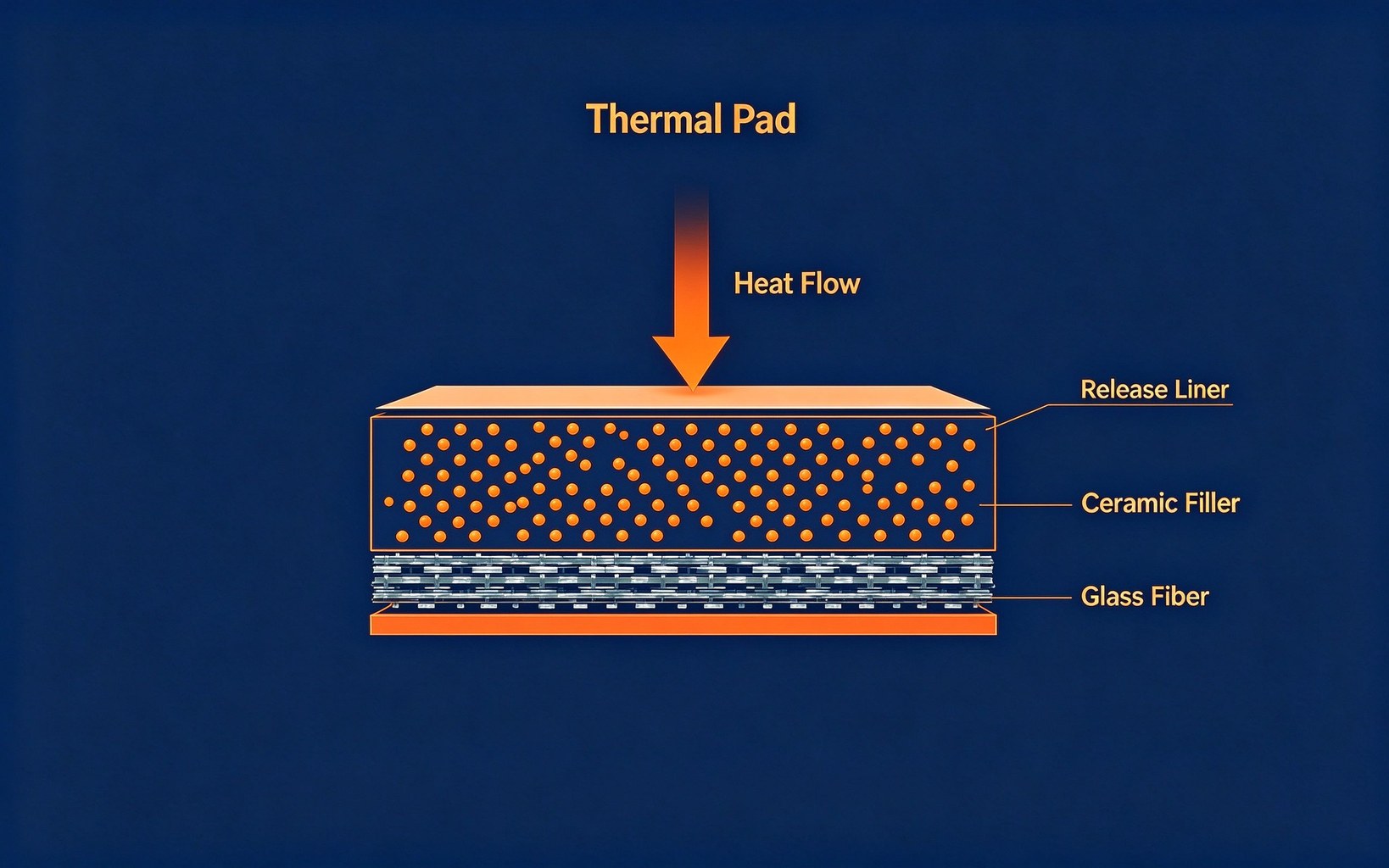
Pure silicone rubber is a poor heat conductor on its own. It becomes thermally conductive when filled with ceramic particles such as alumina, boron nitride or aluminium nitride. Depending on filler loading, thermally conductive silicone pads and greases reach 1–15 W/mK — which is why they are the most common thermal interface materials in electronics. If your application must avoid silicone oil entirely, non-silicone thermal pads are the alternative.