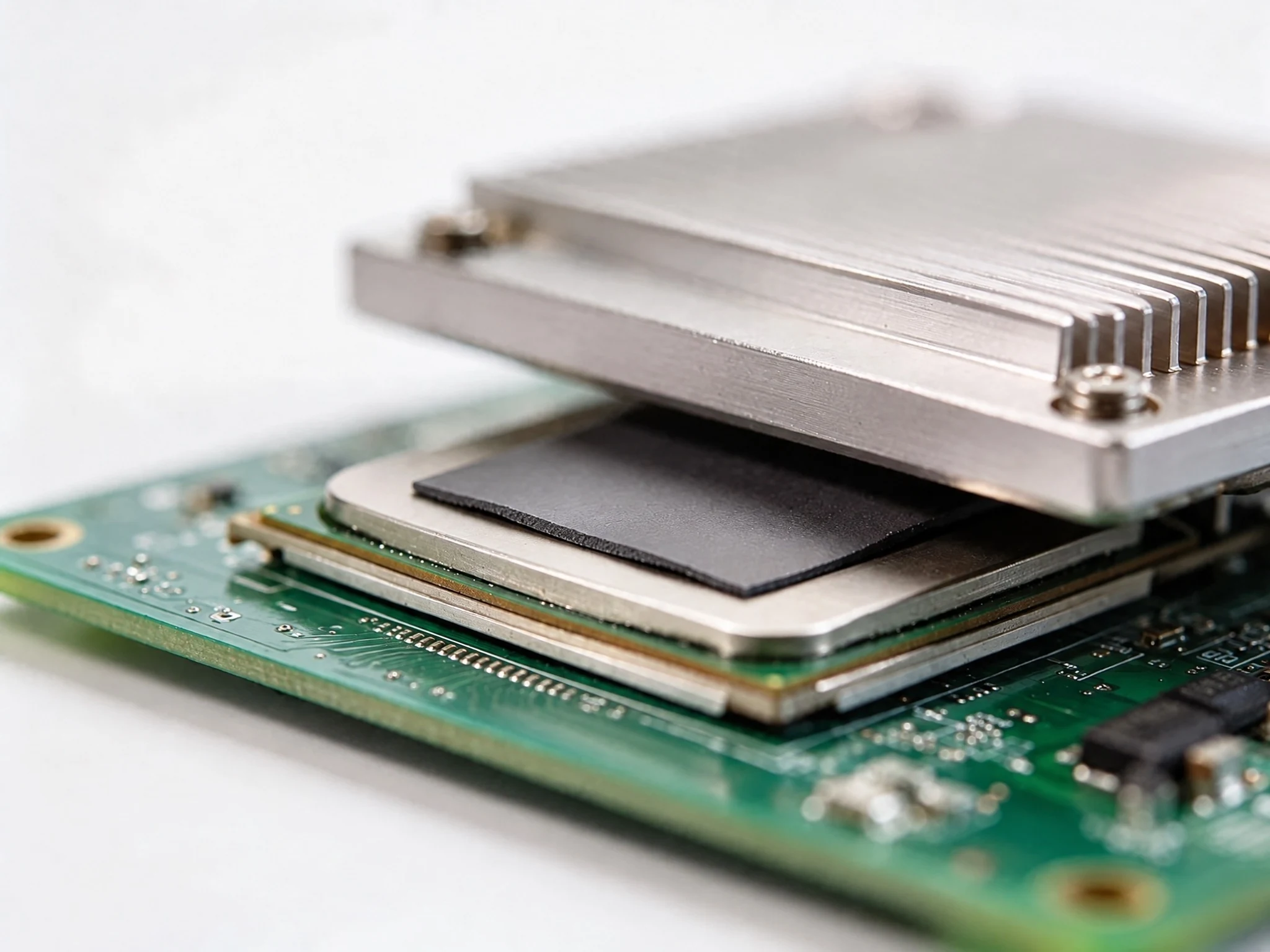
Phase Change Thermal Conductive Material
Fangying’s phase change thermal conductive material is a heat-enhancing polymer thermal material with thermal conductivity up to 4 W/m·K. At 45–55 °C it changes from solid to liquid, filling gaps, absorbing component heat and reducing contact thermal resistance. After liquefaction, thermal resistance drops to as low as 0.018 °C–in/W, improving the reliability of power devices such as CPUs, graphics accelerators and DC/DC power modules.
The material is naturally tacky at room temperature, requiring no adhesive or preheating. Like a thermal pad, it can be pre-formed for easy installation, and like thermal grease, it delivers low thermal resistance after phase change — combining the best properties of both.
Key performance features
- Ultra-low contact thermal resistance — high thermal efficiency after phase change.
- Naturally tacky — no adhesive or preheating required.
- Phase change gap filling — solid-to-liquid at 45–55 °C fills interface gaps.
- Pre-formable — shaped like a pad for easy component installation.
- Composite capability — can be laminated with various materials into composite thermal materials.
- For high-frequency microprocessors — reliable thermal management in demanding processors.
- V-0 flame retardant — safety-rated for electronics.
Typical specifications
| Thermal conductivity | 1 – 4 W/m·K (up to 4 W/m·K) |
| Phase change temperature | 45 – 55 °C (solid to liquid) |
| Thermal resistance | As low as 0.018 °C–in/W after liquefaction |
| Surface | Naturally tacky, no adhesive required |
| Flame retardancy | V-0 rating |
| Compliance | RoHS, halogen-free, HF-controlled |
| Customization | Die-cut to size; composite lamination available |
| Volume | From prototype samples to high-volume production |
Typical applications
- High-frequency microprocessors — thermal interface between processor and heat sink.
- Laptops — compact thermal management in mobile computing.
- Cache chips — controlled heat paths in processor packages.
- Memory modules — heat transfer in RAM and storage modules.
- Computer servers — reliable thermal management in data centers.
- Solid-state relays (SSRs) — heat dissipation in switching devices.
- Power modules — thermal interface in power electronics.
- Image processing chips, ASICs and IGBTs — between heat sinks and electronic devices.
Frequently asked questions
What is the thermal conductivity of this phase change material?
1 – 4 W/m·K (up to 4 W/m·K), confirmed on the material datasheet for each grade.
How does the phase change work?
At 45–55 °C the material changes from solid to liquid, filling gaps, absorbing component heat and reducing contact thermal resistance to as low as 0.018 °C–in/W.
Does it need an adhesive or preheating?
No. It is naturally tacky at room temperature with no adhesive required, and the phase change needs no preheating.
What are its advantages over pads and greases?
It combines both: pre-formable like a thermal pad for easy installation, with the low thermal resistance of thermal grease after phase change.
Is it flame retardant and environmentally compliant?
Yes. It meets the V-0 flame retardant rating and complies with RoHS, halogen-free and HF-controlled requirements.
Send us your application details and we confirm the right grade, packaging and quotation. Samples available within 3–7 days.