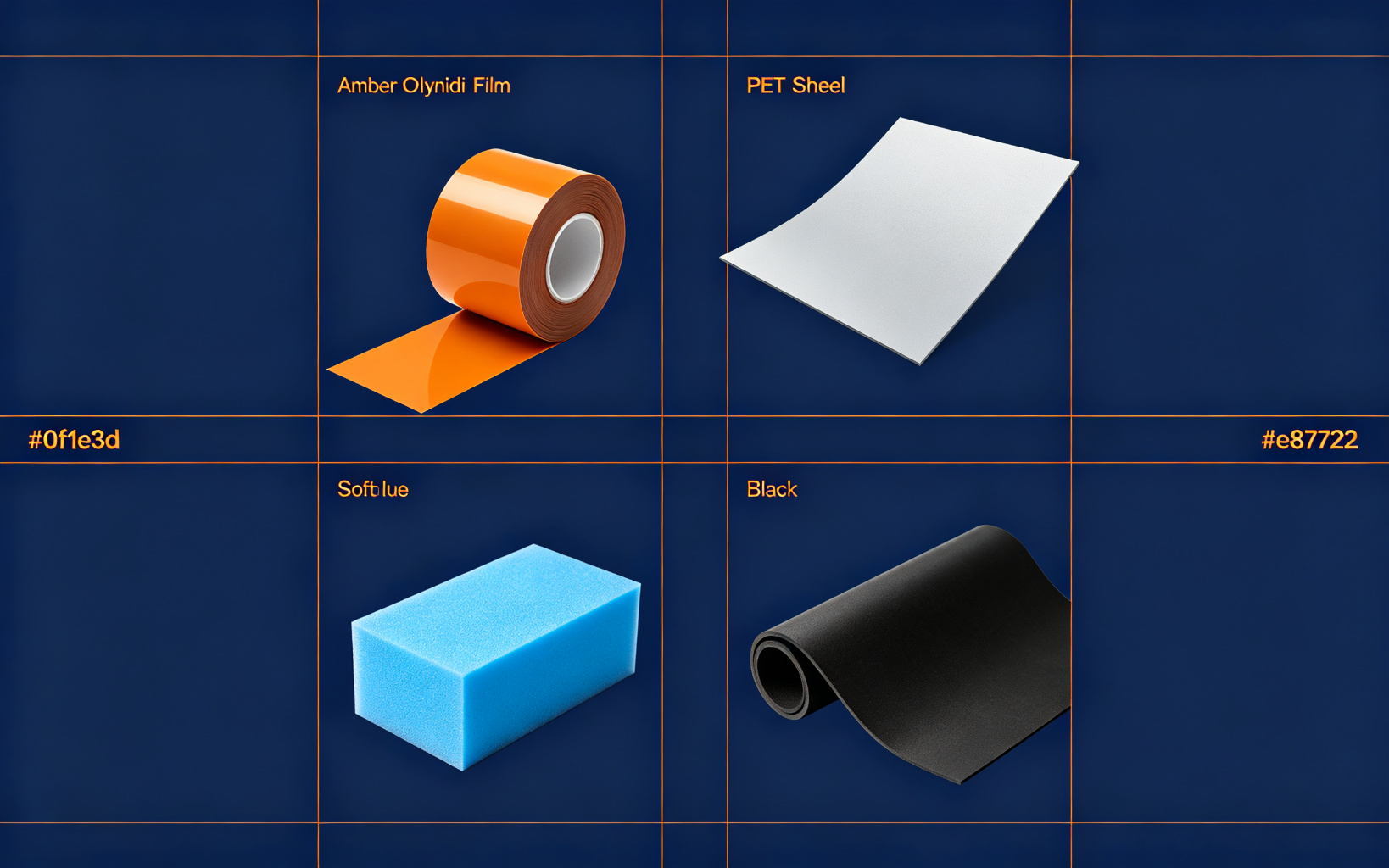
PET, PI, Foam, Rubber: Common Substrates for Precision Die Cutting
The carrier film under your adhesive is often the quietest driver of performance. A double-sided tape is not just the glue — the PET or PI film sets dimensional stability, dielectric strength and temperature ceiling. Here is how the common substrates compare.
PET (polyester) film
The workhorse. 25–125 µm thicknesses, excellent dimensional stability, good electrical insulation, low cost, and a smooth surface that plays well with acrylic adhesives. The default choice for nameplate bonding, display bonding and general industrial applications. Continuous use to ~150 °C.
PI (polyimide, e.g. Kapton®)
The high-temperature specialist. Amber colour, continuous use to +260 °C, outstanding thermal stability, used in reflow pallets, EMI shielding (MIL-STD-285) and aerospace flex circuits. UL94 V-0 / VTM-0 grades are commonly requested. Cost is roughly 5–10× PET, so specify it only when temperature or UL flammability genuinely requires it.
Foam substrates
PU, PE or acrylic foam provide bonding plus gap-filling and stress relief in one part. Ideal when surfaces are uneven or the assembly needs vibration damping — the VHB family is the classic example.
Rubber & elastomer substrates
Neoprene, silicone, EPDM and fluorosilicone used when the part itself must seal, gasketing, or provide EMI shielding. Usually die-cut to thickness tolerances of ±10% rather than the ±10 µm achievable on films.
How to choose
- Bonding flat rigid parts under 150 °C → PET
- Reflow / high-temperature / UL94 → PI
- Gap filling / vibration damping → acrylic or PU foam
- Sealing / EMI / weather resistance → rubber or silicone foam
Tell us your application — we will recommend a substrate →