Automated Assembly
Roll-Fed Double-Sided Tape for High-Speed Assembly
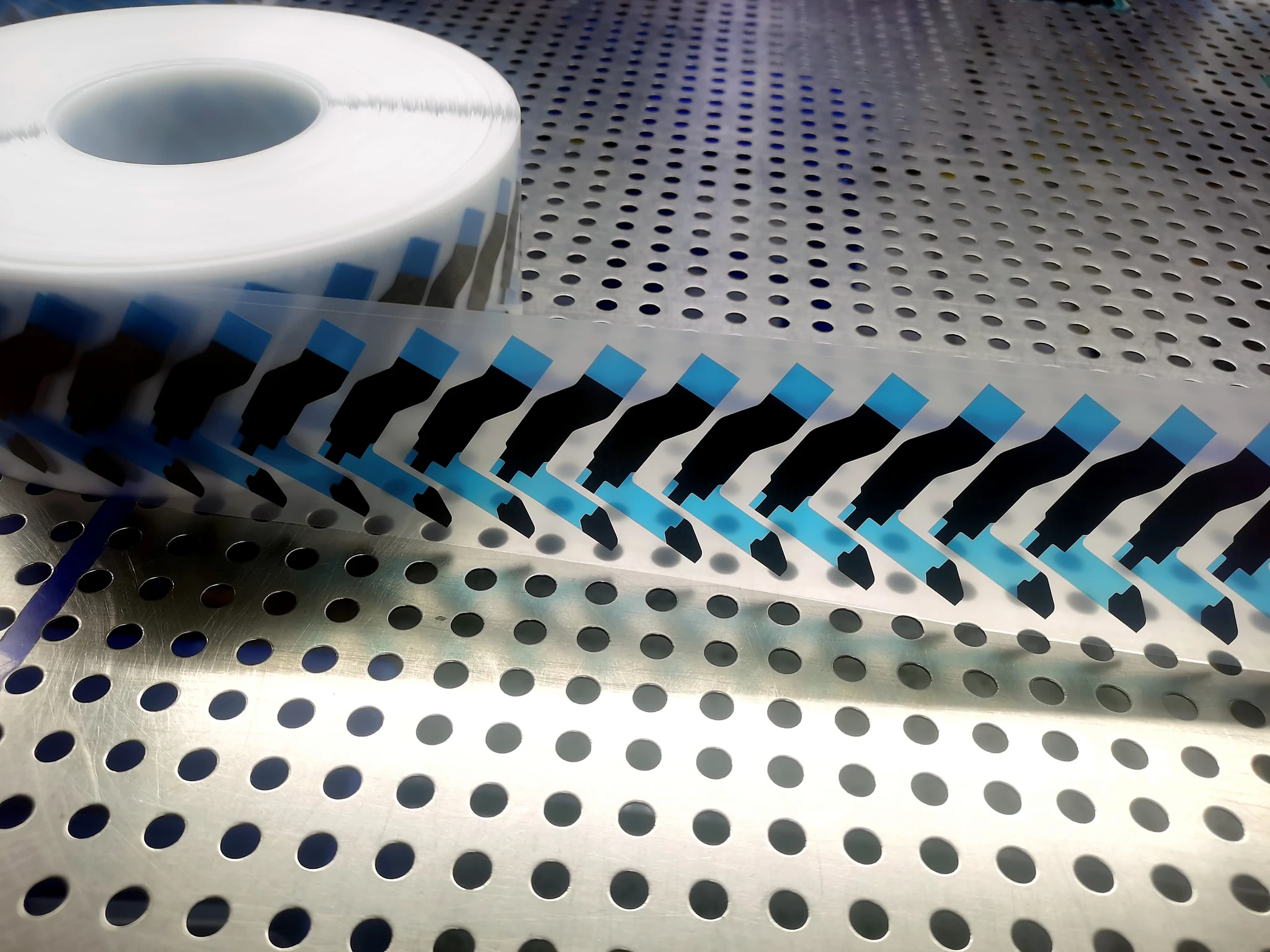
Roll-form double-sided tape (jumbo-roll or roll-stock double-coated tape) is pressure-sensitive adhesive coated on both sides, backed by a release liner. Unlike precut sheets, its advantage is automated, high-volume production: unwind → lamination → die-cutting → liner rewinding runs continuously in one pass with minimal manual handling.
Why roll-fed die cutting wins on volume
- Continuous production — rotary die on a moving web, no sheet-by-sheet loading.
- Low labour — kiss-cut parts on a liner feed directly into pick-and-place machines.
- Material efficiency — nested layout on the roll minimises waste vs flat-bed.
- Consistent pitch — parts presented at an exact spacing for automated dispensing.
Typical capabilities
| Materials | Double-coated tissue, PET, foam, acrylic and thermal tapes |
| Web width | Up to ~500 mm, slit to your width |
| Pitch accuracy | ±0.2 mm on the carrier liner |
| Cutting | Rotary die cutting (kiss cut on liner) |
| Presentation | Continuous roll, tape-and-reel, or fan-folded |
| Volume | Ideal for 100k+ pieces/year |
Applications
- Consumer electronics — display and housing adhesive pads on automated lines.
- Automotive — trim clips, sensor pads, tape backing in high volume.
- Home appliances — panel bonding, nameplate attachment.
- FPC/PCB — thermally and electrically conductive kiss-cut parts at fixed pitch.
FAQ
What volume makes roll-fed worthwhile?
Above roughly 50–100k pieces/year the rotary process pays back in tooling and labour savings. Below that, flat-bed or laser may be more economical.
Can you handle both kiss-cut and through-cut on the roll?
Kiss-cut (parts on liner) is the standard for automated lines. Through-cut loose parts are better on sheets or tape-and-reel.
Tell us your annual volume and the part drawing. We will quote rotary vs flat-bed and recommend the most cost-effective process.